Tuesday, July 17, 2012

Jefferson's Garden

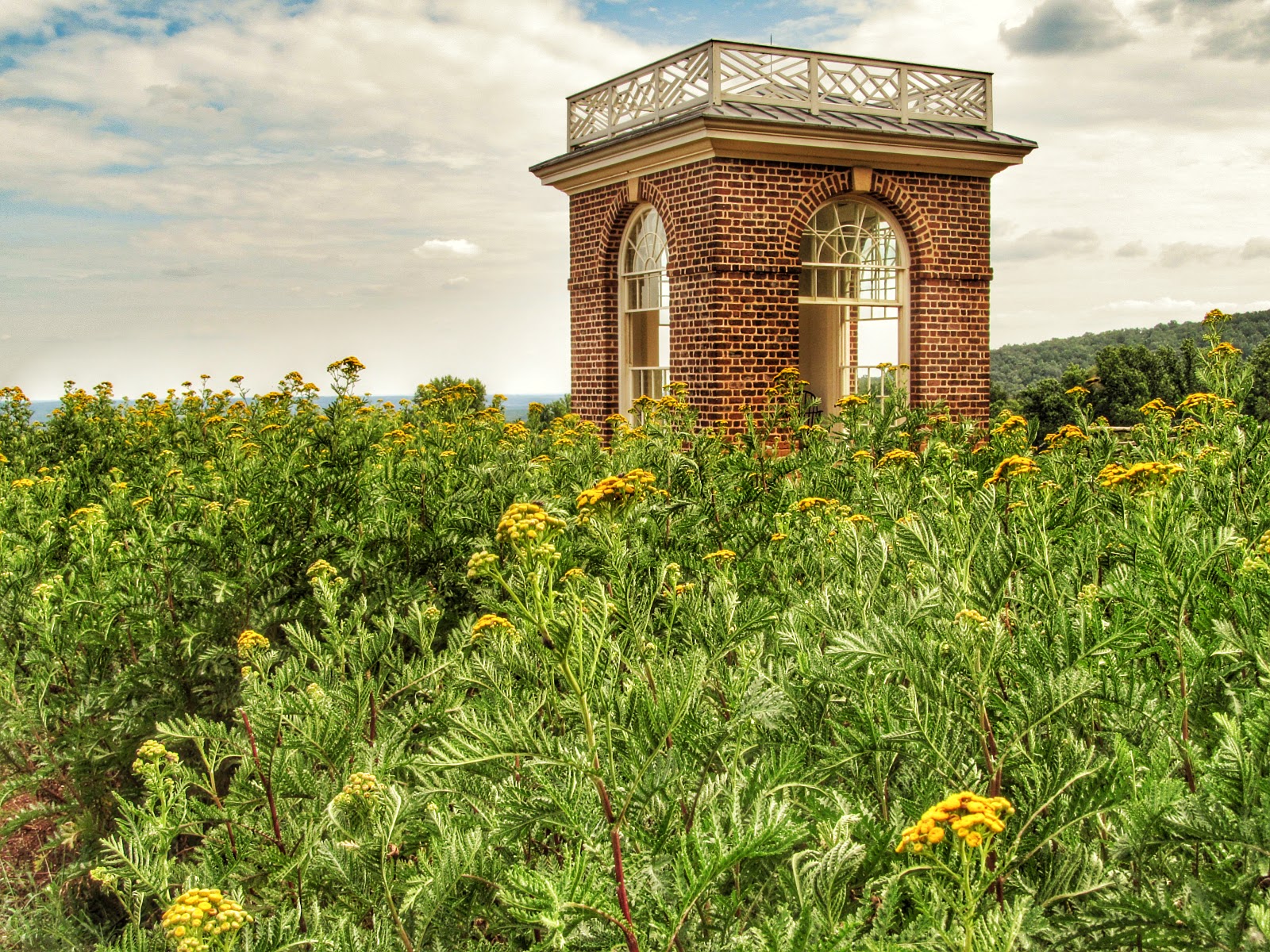
Jefferson's garden at Monticello - July 2012


Note : You can see all of the pictures I took during my visit to Monticello here at the set I have posted on Flickr.


During my week at Monticello one of the things I enjoyed most was seeing  Jefferson's garden and learning a little more about his approach to gardening.

The mere sight of Jefferson's 1000 foot long garden at Monticello is impressive.  The garden has been painstakingly reconstructed on the same site and is currently growing the same vegetables.  I enjoyed walking through and seeing many of the same items we know grow in our own small family garden.

Jefferson is sometimes given erroneous credit for single handedly introducing certain vegetables to the United States, like the tomato. He did, however, help to advocate for increased popularity of some vegetables which were not common in the United States at the time.  His garden at time would have definitely been a "revolutionary garden".

Sea Kale in Jefferson's garden at Monticello - July 2012

As you walk the garden it is impossible to not be touched by the beauty of the surroundings.  The garden is built on the side of the mountain upon which Jefferson built Monticello with an amazing view looking out over the valley and the towering big mountain of Montalto keeping watch.

In addition to the garden, Jefferson also surrounded himself with beautiful flower beds and trees.  The flower beds surrounding the house have a wide variety of species.  He also had systems created to collect rainwater runoff to help water his plants.

Jefferson's flower beds at Monticello - July 2012

Jefferson's flower beds at Monticello - July 2012

If you visit Monticello I would recommend the garden tour.  It was a very informative 45 minute tour and I learned a lot about Jefferson's involvement with plants on the grounds.  I wanted to read up on the garden when I returned home so I purchased the book "A Rich Spot of Earth" by Peter Hatch.  Hatch has been the gardener at Monticello since 1977.  I highly recommend this book if you want to learn more about this topic.  It is both a coffee table book with incredible photography and informative read with historical perspective and background on the types of vegetables grown.  This book is a must if you have an interest in Jefferson's garden.

As I walked around Monticello last week I found myself thinking about how Jefferson would like use to remember him today if we could only focus on one of his talents.  Would he like us to think of him as the one who crafted our most important document?  Would he want us to think of him as an architect first as we wait for hours to take a tour of his 200+ year old house?  Is he most proud of his contributions as a gardener?  What of his ability to adapt and implement the inventions around him in an attempt to create a more comfortable and efficient life?  I personally think his answer might vary from day to day but last week as I walked around his grounds I thought first of his ability to create a tranquil and beautiful place on this "rich spot of earth".


Flowers at Monticello - July 2012

Friday, July 13, 2012

Teaching Jefferson - Reflecting on Monticello


Background : I applied last year for a Barringer Research Fellowship to study Thomas Jefferson at Monticello for two weeks this summer.  my research proposal included researching Jefferson and creating a Twitter feed in which followers could learn a little bit about him each day of the year through links, quotes, pictures,videos, etc. I was contacted by the educational staff at Monticello and they asked me if instead I would participate in a week long teacher forum they were conducting to help in the development of new online teacher resources for Monticello.  It sounded like a unique opportunity to mix history and technology so I jumped at the chance.  I worked with the Monticello educational staff and teachers from different parts of the county with a variety of connections to Monticello on July 8-12, 2012.

Jefferson's Monticello - July 12, 2012

“The boisterous sea of liberty is never without a wave”.
- Thomas Jefferson


One of my personal struggles as a teacher is finding the time to prioritize the manner in which I teach U.S. history.  There are so many people, events and topics which I have enjoyed learning about and gathered resources to teach. I am challenged each year to negotiate the pace of my school year to accommodate them all.  

This week I have been fortunate enough to spend an entire week at Monticello working with the educational staff here as well as fellow teachers from different parts of the country.  We have had access to numerous resources and experts.  To borrow an often used phrase, it has been a lot like trying to get a drink from a firehouse.  I always enjoy listening to someone who has devoted a large portion of their life to the study of one topic.  You can almost see the passion ooze from their pores as they present and share. This week we have listened to scholars and researchers share their depth of understanding on Jefferson, an individual who I believe is probably one of the more intriguing and complex personalities of the founding era.

At the conclusion of workshops such as this - periods of time where I am afforded the luxury of experiencing history on a deeper level - my biggest hurdle also provides an exhilarating opportunity. How do I synthesize all this information into a condensed version which we help my 8th grade students understand this individual and the broader context of the time in which he lived?

It would not be difficult for me to devote an entire month to the study of Jefferson for there is truly that amount of compelling and engaging content available.  But reality forces me to realistically utilize about five days specifically on Jefferson, roughly 250 minutes.  

As the week here at Monticello progressed, I tried to identify several major themes that I would like my students to learn about Jefferson.  My Jefferson themes include: innovation, politics, role in western expansion, and complexity.

Gardens at Monticello - July 12, 2012

I think one of the most powerful and currently relevant aspects of Jefferson's personality is his ability to innovate.  I truly believe that the course of our nation's history in this century will be determined by our ability, or inability, to innovate.  Jefferson is often thought of as an inventor but as the Monticello curator told us in one of our lectures this week, he only truly invented one item in his life - a specifically designed plow.  What he was brilliant at was the ability to use and modify things to fit his needs. Let's be honest, very few of us will ever invent something like Twitter,  but many of us will become successful in learning how to use something like Twitter to met our needs.  I am currently half way through the Steve Jobs biography and I have found it very interesting that on multiple occasions during my time at Monticello someone has made a comparison between Jefferson and Jobs.  I think sharing with students the ways in which Jefferson was an innovator is not only "cool", but also demonstrates to students the power of design and adapt the items around you to best fit your needs.

We discuss the contributions of Jefferson politically when we study the American Revolution, but I typically also discuss the importance of Jefferson taking office as a member of a different political party and the accomplishments / tribulations of his presidency.  If I had to select one big picture message that I hope my students grasp from our discussion of Jefferson politically, specifically in terms of his contributions writing the Declaration of Independence, it would be the understanding that he utilized the writings and philosophies of many other individuals.  I think the importance of this is similar to the importance of understanding that he was more of an adapter than an inventor.  Jefferson was obviously an incredibly gifted and talented individual - I always use JFK's quote about Jefferson dining alone in the White House - but if we only hold him up as this amazing, one in a billion type of super intellectual I think we are missing a huge opportunity to teach our students that often times great ideas are truly built upon the shoulders of giants.  Teaching about Jefferson's research on the great political philosophers of history is an opportunity to again demonstrate to our students the importance of research, reading and scholarship. I also like to show students his rough draft of the Declaration of Independence. If Jefferson can survive a little editing, I think we all can from time to time.

I think it is important for my students to appreciate the impact Jefferson had on our home state of Missouri as a result of his policy and personal beliefs pertaining to western expansion. As a Missouri resident I see the impact of Jefferson on a daily basis.  The land on which I live and teach is of course part of the Louisiana Purchase and when I visit our state capital I drive to Jefferson City.  The Corps of Discovery is also strongly intertwined in our local history since the expedition traveled through our county.  Beyond the political aspects of western expansion, I also feel I owe Jefferson a debt of gratitude for the passion he shared in regards to western expansion.  Jefferson helped create a buzz and a sense of urgency about exploring and claiming the west.  As someone who has lived their entire life in the flyover states, that passion brings me a little closer to Jefferson.  Virginia will always own Jefferson but I feel a connection to him as a Missourian as well.

The contradictions in Jefferson's life make him a complicated individual to teach students but it also provides a powerful lesson.  I have found that students in my classroom today like their history to be wrapped up in a nice, tidy package that they can grasp so that they can understand it and move on.  We know that history doesn't work that way.  History is messy and complicated.  Jefferson's life is a great illustration of how no one is perfect in everyone's eyes and no one can be easily defined.  I don't think that Jefferson is unique in this regard, complexities can be found in the lives of all of the Founding Fathers, but I think Jefferson's life is an interesting case in which to discuss some of these issues.

Jefferson statue on University of Virginia campus

My challenge now as I leave Monticello with a thousand ideas bouncing around inside my head is to cultivate them down to several activities that will teach my students about Jefferson in the context of those four themes.  This is a part of my profession that I love but it is also a challenge, especially in today's age of technology which provides so many directions that it is difficult sometimes to weed out what best meets your needs.  I will spend some time this summer to formulate some Jefferson lessons and when I do I will share them on this blog.

I would like to thank the Monticello education staff for an absolutely amazing week of learning, discussing and sharing.  I am afraid if I start naming names I will leave someone out.  Their staff made all of us feel so welcome and I never felt as if I was invading their turf, rather I felt as if I was being welcomed to experience the work they enjoy and for which they have so much passion.  The other participating teachers that I shared the week with are equally  incredible.  We shared ideas and talked about our profession in a way that is becoming increasing rare in education and I appreciated the opportunity.  There is just something special about discussing the founding fathers while enjoying a good meal.  The week helped my charge my batteries and get me excited about my next chance to teach Jefferson and for that I thank everyone who made it possible.

View from Montalto - the big mountain overlooking Monticello

Thursday, January 26, 2012

Podcast #215 - "Watching" the State of the Union Through the Eyes of Twitter

Today's podcast is sort of a rambling (consider yourself warned) about how I watched my Twitter feed about the State of the Union Address last night before I listened to it on my own.  Viewing events like debates, speeches and sporting events is definitely different when you are commenting and watching it live on Twitter.  What does this say about us socially?  Do you watch live events with your phone or i-Pad in one hand commenting to Twitter?  Please listen to the podcast and then leave a quick comment.


Direct link : Speaking of History Podcast #215 "Watching the State of the Union Address Through the Eyes of Twitter" - MP3 file (9 minutes)


Wednesday, January 25, 2012

Podcast #214 - Antique Radio Time Machine

Hello.  Today's podcast is part do-it-yourself, part technology.  I discuss how in a couple of minutes we took our family antique cabinet radio from the 1930's and soon had it playing Glenn Miller big ban music and reports from D-Day.  


Direct link : Speaking of History Podcast #214 - Antique Radio Time Machine - MP3


Links from podcast:


Old World Radio - great site to download original music, comedy shows and dramas


Montgomery Ward Airline 62-215 Radio - 1935


Sunday, January 08, 2012

Podcast #213 - I'm Back

Hello. It has been 535 days since my last podcast but I'm back.  I really enjoy podcasting and it is my hope to rejuvenate the post here in 2012.  I have been busy the past 2 years working on my doctorate and that time that I used to spend on the podcast has largely been consumed by doctorate work.  I am now finished with my course work and am writing my dissertation.  Today's podcast is a short recap of what has been happening in the past two years and my desire to get back on track.  Thanks for listening.


Friday, December 02, 2011

WordFoto App

I have used Wordle for years in class but recently have also been playing with the WordFoto app on my I-pad.  WordFoto isn't as "texty" as Wordle - meaning that it is not intended to take an entire speech or paragraph like Wordle.  It is more about taking a photo and adding text elements to the photo.  


I have enjoyed taking some family photos and making this year's Christmas card and making an graphic of a Husker football player.  I think it also has potential for making interesting images of historical figures and places.  Below is a quick WordFoto made of a picture I took of Mount Vernon a couple of years ago while attending a Gilder Lehrman summer workshop.  I have include the original photo as well to allow you to compare.  


The WordFoto app is currently available only as an Apple app.  If you would like to check out some great examples of what WorldFoto can do check out their Flickr page.

Thursday, December 01, 2011

New Pearl Harbor Interactive from National Geographic

As we prepare to observe another anniversary of Pearl Harbor, an excellent new interactive site from National Geographic is available for teachers to use in the classroom.


Thanks to @explorehistory for sharing this resource on Twitter.

Tuesday, July 19, 2011

2011 Keizai Koho Center Fellowship - Okonomiyaki

This is the sixth in a series of blog posts describing my experiences as part of the 2011 Keizai Koho Center Fellowship Program.

Okonomiyaki at a Hiroshima restaurant 

Okonomiyaki mid process on a hot plate

Our KKC group making Okonomiyaki in Hiroshima 

One Japanese food dish from the my recent trip to Japan deserves its own blog post – Okonomiyaki.  Wikipedia describes okonomiyaki as “a Japanese savory pancake containing a variety of ingredients and is derived from the word ‘okonomi’ : what you want and ‘yaki’ : grilled”.  My host family prepared it for me during my home stay and then we visited a restaurant as a group where we prepared one for ourselves on a hot plate which sat in front of us.


The okonomiyaki is a mixture of batter, cabbage, pork and optional items including squid, octopus and cheese.  On top of this combination are placed noodles, a fried egg, okonomiyaki sauce and mayo.  My host family also sprinkled the finished plate with dried tuna shavings and dried seaweed.  The dish is most popular in the Kansai and Hiroshima areas.  Different regions have different proportions of ingredients. The mixture is fried on a hot plate and turned over several times like a pancake with spatulas.  It was relatively easy to eat with chopsticks and has so many ingredients it is easy to find something that everyone likes.


Thursday, July 14, 2011

2011 Keizai Koho Center Fellowship - Baseball in Japan

This is the fifth in a series of blog posts describing my experiences as part of the 2011 Keizai Koho Center Fellowship Program.

My new favorite Japanese Baseball player
Poster promoting the game we attended

One of the things I hoped to have an opportunity to do while in Japan was watch a major league Japanese baseball game.  This ultimately was a reality because of the generosity of my host family.  A week prior to visiting Japan my host family contacted me to see what I would like to do during my homestay in Japan.  I replied to Noriko, my host, and explained that if possible I would love to attend a game.  She said it would be possible to attend a game on July 3rd at Osaka. 
Noriko, Mizuki (Noriko’s niece) and I took a combination of subways and trains from Kyoto to Osaka to watch the Osaka Orix Buffaloes and the Fukuoka SoftBank Hawks play at the Kyocera Osaka Dome.  The teams in Japan are sponsored by companies and the corporate names are included in the name of the team – Orix sponsors the Osaka team and SoftBank sponsors the Fukuoka team.  The Osaka Orix Buffaloes are the team Ichiro Suzuki played for in Japan before coming to the United States to become an All-Star with the Seattle Marines.  Ichiro is one of my favorite players to watch and there were a ton of advertisements in the stadium featuring him promoting a Japanese brand of beer.

I met these super fans for the Osaka team prior to the game
The couple which sold us our tickets to the game

We arrived at the Osaka Dome looking to get tickets for the game.  We wanted to get some cheap tickets so we went to the area of the stadium where the general admission seats are sold for the game.  We were just walking up to the ticket booth to buy some tickets, which cost about 1,500 yen each, when a family approached us and asked if we were looking to buy tickets.  Noriko explained that we did want to buy some tickets.  The family explained they had some extra tickets since their friend was unable to make it today.  He offered to sell us two tickets for 1,000 yen – about $8 in U.S. currency.  We agreed and then when he saw we needed a total of three tickets he gave us the third one for free and then handed me the jersey the team was giving away that day.  I was so thrilled to get the tickets and the free jersey that I told him thanks in Japanese repeatedly and asked to take a picture with his family.  We were in!

Enjoying the game with my host family

We entered the stadium and found it to be very much like any domed stadium in the United States – fans milling around, concession stands and places to buy souvenirs.  I went to the souvenir stand to get some items to take home.  I saw many fans walking around with a large towel they wore around their neck which had the team name and featured the name and number of their favorite player.  I decided I needed one of these so I bought one with the name of my new adopted favorite player in Japan – #9 Tomotaka Sakaguchi of the Osaka Buffaloes.  I also found a team autographed baseball with Sakaguchi’s signature.  I also picked up a couple of game programs for free.  The programs were really cool and even gave directions for specific team songs and chants as well as directions for waving your towel in a certain manner.

Shopping for souvenirs at the game

View from our seats in the upper deck, slightly right field

The concourse was full of food options included a hot dog stand, traditional Japanese cuisine (including octopus and sushi), a Kentucky Fried Chicken and a McDonald’s.  I had not yet tried a burger at a McDonald’s in Japan and the other options didn’t appeal to me so I decided this was the time to do a taste comparison.  I got a Big Mac, fries and a Coke.  The Big Mac tasted pretty close the same as in the states with the exception of maybe a little more pepper on the patty.  My hosts also got burgers at McDonald’s. 

McDonald's concession stand inside Osaka Dome

We reached our seats, the first row of the upper deck of the Osaka Stadium just to the left of center field.  It was much like an American game except for the dressed up samurai warriors running around the field and the chanting from the fans.  The fans for the opponent were louder than their home counterparts.  They had a band with drums and trumpets while waving several very large team flags. The fans also did a unique celebration using different colored balloons.  At the end of the 6th inning half of the stadium blew up large yellow balloons and then between innings on cue half of the stadium let them go, causing them to fly in the air a short distance and then fall to the ground.  The action was repeated in the middle of the 7th with the opposite side of the stadium doing the same thing with pink balloons.  I had never seen anything like it at an American stadium.

Fans prepare for the pink balloon launch at the game

The game was a defensive battle with the score at 1-0 in favor of Osaka when we had to leave in the 8th inning to catch the train back to Kyoto in time. The game itself wasn’t really all that different than one in the states with the exception of a more bunt attempts.  Each team had a couple of American players each and the starting pitcher for Osaka was an American.  It was fun day at the ballpark and I’m glad that I can say that I was able to attend a game in Japan and I have a new favorite player to follow in Japan.

Enjoying a ice cream helmet sundae at the game

Osaka Dome

Monday, July 11, 2011

2011 Keizai Koho Center Fellowship - Tokyo is One LARGE City

This is the fourth in a series of blog posts describing my experiences as part of the 2011 Keizai Koho Center Fellowship Program.

View of Tokyo from 45 floor of Ritz-Carlton in midtown Tokyo

 
I must admit that I was astounded by the sheer number of people in the city of Tokyo.  Those of you who know me well know that I grew up in Howells, Nebraska - a small farming village in northeast Nebraska with an official 2000 census population of 632 people.  We stayed in Tokyo on this fellowship for a total of four nights.  Tokyo is the world's most populated metropolitan area with a total of 35 million people.
 
View of Tokyo from 40th floor of Tokyo Dome Hotel

 
It was hard for me to get a grasp of what 35 million people look like until I open the window to my hotel room at the Tokyo Dome Hotel.  My room was on the 20th floor (the hotel has an observation lounge on the 45th floor).  It was about 11:00 PM at night when we got into our hotel room and when I opened the window I could see nothing but lights from skyscrapers in every direction.  The site was amazing and even more so considering that many buildings in the Tokyo area are not fully lit at night due to the efforts to conserve energy following the disaster at the Fukushima nuclear plant in the 3/11/11 earthquake.  The next morning I looked out over the city in the dawn of the morning light and it was even more impressive than the evening before.  It was now daylight and in every direction not only could I see buildings, but skyscrapers in every direction going on forever on the horizon.  It was very impressive.

I took some pictures of the Tokyo skyline from my hotel window but also ventured to higher locations including the 45th floor of the Tokyo Ritz-Carlton hotel and the 40th floor of the Tokyo Dome Hotel and took pictures and video from these locations.

Video of Tokyo from 45th floor of Ritz-Carlton hotel

 
The sheer number of people of in Tokyo is almost too much to comprehend.  The urban core of Tokyo has 2,700 square miles with a population density of 12, 296 people per square mile.  I was impressed.


Me looking out over Tokyo from the 40th floor of the Tokyo Dome Hotel